

Data
Global Aid Retrenchment and Myanmar's Humanitarian Crisis (2020–2026)

2 months ago
The global international development and humanitarian assistance architecture is undergoing a systematic transition from the expansionary policies of the early 2020s to a period of severe fiscal contraction and strategic reprioritization.
Between 2020 and early 2026, Official Development Assistance (ODA) reached record highs during the dual crises of the COVID-19 pandemic and the war in Ukraine. However, it has now entered a stage of significant structural shrinkage. For the first time since the OECD's Development Assistance Committee (DAC) established current reporting standards in 1969, many of the world’s leading donor nations are signaling or implementing massive multi-year budget cuts that are reshaping the political-economic landscape of aid.
In Myanmar, these global instabilities coincide with the catastrophic domestic political and humanitarian collapse triggered by the February 2021 military coup. By 2026, Myanmar’s situation—often called a "forgotten crisis"—is not only competing for rapidly dwindling resources but is also navigating humanitarian aid blockades imposed by the Military Council and logistical difficulties within fragmented, conflict-affected territories.
This report links the macroeconomic outlook of global Official Development Assistance (ODA) with the micro-level breakdown of life-saving services in Myanmar, assessing the structural changes defining the humanitarian sector in an era of resource scarcity.
The Global Macroeconomic Context of ODA: 2020–2026
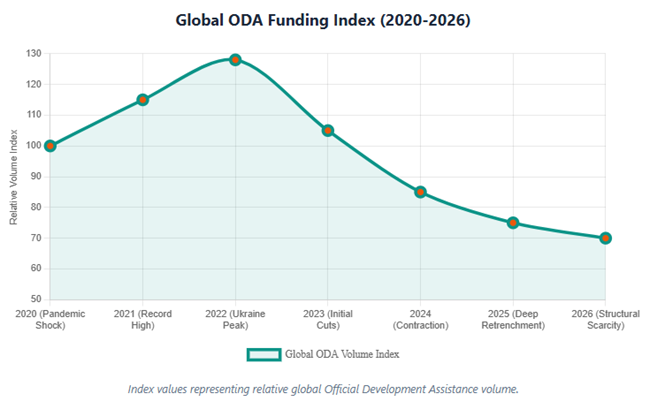
The trajectory of global ODA over the past six years can be described as a period of rapid expansion due to crises, followed by structural spending cuts. In 2022, ODA provided by OECD DAC members reached its highest level in absolute terms. This was not due to a broad increase in long-term development funding but rather because of refugee costs within donor countries and extraordinary support for Ukraine. Aid for Ukraine (including humanitarian, budget, and refugee costs), which was less than $20 billion in 2021, jumped many times over in 2022.
By 2024, the "Ukraine effect" had stabilized. Due to high inflation in donor countries, energy crises, and domestic political pressures, international aid declined for the first time in six years. Total ODA from DAC members fell from approximately $215 billion to $212 billion, which is about 6% to 7.1% less in absolute terms than in 2023. This reduction is due to decreased contributions to multilateral organizations, falling aid for Ukraine, smaller humanitarian budgets, and reduced spending for refugees within donor countries. Projections for 2025–2027 are even more concerning. Analyses based on OECD data indicate that as donor budget cuts take effect, total ODA could fall a further 9% to 17% between 2024 and 2025, suggesting that aid levels could return to pre-pandemic levels even as global needs remain at record highs.
Timeline
· 2020 – Baseline: Significant increase in health and emergency spending related to the COVID-19 response.
· 2021 – ODA continues to grow due to the pandemic and recovery measures.
· 2022 – Record ODA: Double-digit percentage growth in absolute terms due to the war in Ukraine and refugee costs in donor countries.
· 2023 – Aid increases further as global humanitarian needs (including protracted crises) reach their peak.
· 2024 – ODA declines for the first time after at least five years of growth; total DAC ODA fell by about 7% in absolute terms.
· 2025 (Projection) – OECD scenario summaries predict a further decline of 9% to 17%, reflecting structural spending cuts among major European donor countries.
· 2026 (Projection) – Global humanitarian strategists warn that while millions more people need help, funding levels could drop back to 2019–2020 levels.
ODA Summary Table
|
Year |
Total DAC ODA |
Year-on-Year Change |
Key Drivers / Reasons |
Remarks / Sources |
|
|
(USD Billion) |
Percentage (%) |
|
|
|
2020 |
125 |
Baseline (+10 vs 2019) |
COVID-19 pandemic response |
OECD DAC Data |
|
2021 |
169 |
+11 |
Continued pandemic support measures |
OECD DAC Data |
|
2022 |
211 |
+16.8 |
Ukraine war + In-donor refugee costs |
Record High; OECD DAC Preliminary Data |
|
2023 |
223.7 |
+1.8 |
Humanitarian needs reaching their peak |
Ukraine effect stabilizing; Growth slowing down |
|
2024 |
212.1 |
-7.1 |
Massive budget cuts by major donors |
First decline in 6 years |
|
2025 |
Projection |
-8 to -15 |
US/UK spending reductions |
Possible scenario based on OECD and donor budget plans |
|
2026 |
Projection |
Uncertain |
Ongoing fiscal consolidation |
Risk of returning to 2020 levels despite high needs |
Retreat of Traditional Donors: The United States and the United Kingdom
The primary drivers behind the decline in global aid are policy shifts within the United States and the United Kingdom—historically the world's first and third largest bilateral donors. In early 2025, the new U.S. administration initiated a rigorous review and reform of foreign assistance mechanisms. Many new aid commitments were effectively suspended, and advocacy groups and analysts expressed concern that plans to consolidate and drastically reduce accounts managed by the State Department and USAID would lead to the most significant decline in U.S. development and humanitarian spending in decades.
While USAID was not formally abolished, the cumulative effect of these policies led to the suspension of several funding streams, the premature closure of projects, and proposals to fold established accounts into narrower, newer mechanisms. Although subsequent bipartisan negotiations in early 2026 managed to approve foreign aid levels significantly higher than the administration's initial requests, the final figures remained below the benchmarks set by the previous government. This shortfall has left substantial gaps in assistance programs worldwide, including those in Myanmar.
The United Kingdom has implemented a slower but notably deeper reduction in spending. In 2021, the UK reduced its aid budget from 0.7% to 0.5% of Gross National Income (GNI) and has repeatedly postponed plans to return to the 0.7% target. A 2025 House of Commons analysis examined scenarios where defense spending rises to 2.5% of GDP, while ODA potentially falls further to approximately 0.3% of GNI by 2027–28. Should aid reach this level, it would represent the UK's lowest share of national income dedicated to assistance since the late 1990s and would mark one of the most substantial retrenchments among major donors.
These individual national decisions have severe repercussions for the multilateral system. Because a small group of high-income donor nations provides the vast majority of core funding for major agencies—such as the WHO, WFP, and UNHCR—simultaneous spending cuts trigger what one analysis calls an "existential crisis" for the multilateral humanitarian sector. These agencies are being pressured to scale back operations even as they struggle to maintain global coordination and manage high fixed costs.
Myanmar Crisis: Increasing Needs and the Impact of 2025
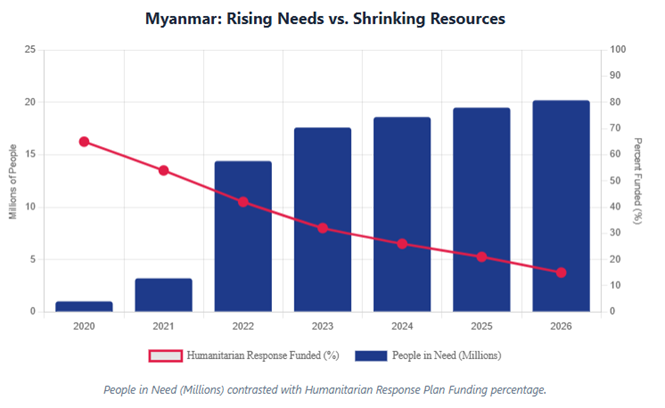
The February 1, 2021, military coup rapidly pushed Myanmar into an extremely vulnerable and dire situation. Over five years, conflicts have spread across the country, and by late 2025, heavy fighting occurred in most townships, especially in the northwest, southeast, and border areas. Civilians face a multifaceted crisis due to mass displacement, collapsing public services, and systematic aid blockades by the Myanmar military.
A significant turning point occurred in March 2025 when a powerful earthquake struck central Myanmar, severely affecting Sagaing, Mandalay, Magway, and Shan State. This natural disaster coincided with areas of intense armed resistance. Instead of facilitating relief efforts, the military intensified operations in some earthquake-hit areas, worsening civilian suffering and hindering emergency responses. According to UN human rights records, there were hundreds of airstrikes and heavy artillery shells in the months following the earthquake, including many attacks during so-called ceasefire periods.
By early 2026, the scale of needs reached levels unprecedented in Myanmar’s modern history:
· People in need of aid – According to the 2026 Humanitarian Needs and Response Plan (HNRP), an estimated 16.2 million people (over 45% of the analyzed population) need humanitarian assistance, which is much higher than pre-coup figures.
· Displacement – Over 4 million people are internally displaced (IDPs), and millions of others have fled to neighboring countries like Thailand, Bangladesh, and India.
· Poverty – The national poverty rate has returned to levels not seen in decades; recent estimates show that over 40% of the population lives below or near the poverty line, with extreme poverty rising significantly in conflict-affected areas.
· Food Insecurity – Millions of people face severe food insecurity due to conflict, displacement, high prices, and market collapse, with many reaching "Crisis" and "Emergency" levels (IPC 3–4).
· Children – UNICEF estimates high levels of malnutrition and stunting, especially among children, pregnant women, and breastfeeding mothers.
The 2026 “Humanitarian Reset”: Special Priorities for Myanmar
In response to declining global funding and worsening aid access restrictions, the United Nations and its partners in Myanmar have adopted a “Humanitarian Reset” for the 2026 planning period. The 2026 Humanitarian Needs and Response Plan (HNRP) is intentionally described as a “laser-focused” and “stripped-back” plan that prioritizes only the most critical life-saving and protection needs.
The 2026 plan targets 4.9 million people, representing a 27% decrease from the 6.7 million targeted in 2025. In reality, the total number of people in need remains extremely high at 16.2 million. This reduction in targeting is occurring proportionally across sectors and reflects a decrease in response capacity and a difficult funding outlook rather than improvements on the ground. Among the 4.9 million targeted, 2.6 million people with the most severe needs (severity levels 4 and 5) are specifically prioritized at an estimated cost of $521 million. Funding requirements for the entire HNRP have similarly narrowed, falling from approximately $1.4 billion in 2025 to $890 million in 2026.
Geographically, the plan covers 227 out of 330 townships in Myanmar (about two-thirds of the country), focusing on areas hardest hit by conflict and the 2025 earthquake. Communities facing chronic vulnerability but no recent severe impact fall outside this “shock-based” framework.
Furthermore, the HNRP has intentionally excluded resilience building, disaster risk reduction (DRR), prevention, and basic social services from the plan, transferring these responsibilities on paper to longer-term development frameworks such as the UN Transitional Cooperation Framework (TCF). However, in practice, due to global spending cuts, few development actors have the resources or political capacity to fill this gap. This leaves millions of people who are no longer “prioritized” in humanitarian plans essentially abandoned.
The 2026 “Humanitarian Reset”: Special Priorities for Myanmar
In response to declining global funding and worsening aid access restrictions, the United Nations and its partners in Myanmar have adopted a “Humanitarian Reset” for the 2026 planning period. The 2026 Humanitarian Needs and Response Plan (HNRP) is intentionally described as a “laser-focused” and “stripped-back” plan that prioritizes only the most critical life-saving and protection needs.
The 2026 plan targets 4.9 million people, representing a 27% decrease from the 6.7 million targeted in 2025. In reality, the total number of people in need remains extremely high at 16.2 million. This reduction in targeting is occurring proportionally across sectors and reflects a decrease in response capacity and a difficult funding outlook rather than improvements on the ground. Among the 4.9 million targeted, 2.6 million people with the most severe needs (severity levels 4 and 5) are specifically prioritized at an estimated cost of $521 million. Funding requirements for the entire HNRP have similarly narrowed, falling from approximately $1.4 billion in 2025 to $890 million in 2026.
Geographically, the plan covers 227 out of 330 townships in Myanmar (about two-thirds of the country), focusing on areas hardest hit by conflict and the 2025 earthquake. Communities facing chronic vulnerability but no recent severe impact fall outside this “shock-based” framework.
Furthermore, the HNRP has intentionally excluded resilience building, disaster risk reduction (DRR), prevention, and basic social services from the plan, transferring these responsibilities on paper to longer-term development frameworks such as the UN Transitional Cooperation Framework (TCF). However, in practice, due to global spending cuts, few development actors have the resources or political capacity to fill this gap. This leaves millions of people who are no longer “prioritized” in humanitarian plans essentially abandoned.
Comparison of 2025 and 2026 HNRP
|
HNRP Components |
2025 |
2026 |
Strategic Rationales |
|
|
Actual / Target |
Projection / Target |
|
|
People in Need (PiN) |
19.9 Million |
16.2 Million |
Limited viewing focused only on shocks caused by conflict and natural disasters. |
|
People Targeted |
6.7 Million |
4.9 Million (-27%) |
Directly reflects the decrease in response capacity and a difficult funding outlook. |
|
Prioritized Target |
3.4 Million |
2.6 Million |
Focusing on severity levels 4 and 5; prioritizing "Life-saving" over "Resilience." |
|
Funding Requirement |
USD 1.4 Billion |
USD 890 Million (-36%) |
"Hard decisions" made due to the global funding squeeze. |
|
Geographic Coverage |
Nationwide (330 Townships) |
227 Townships (69%) |
A "shock-based" framework focusing only on the hardest-hit areas. |
Detailed Sectoral Analysis
Conclusion: Structural
Collapse of Health and Nutrition
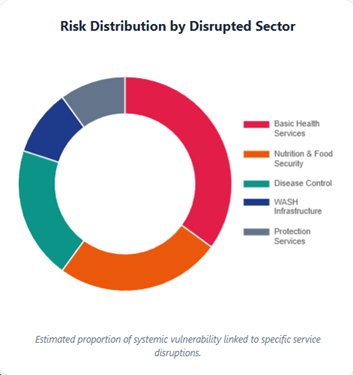
The impact of declining aid is particularly evident in the health and nutrition sectors. In 2025, the suspension of U.S. funding and broad cuts to international health programs led to the sudden cessation or scale-down of numerous life-saving operations across Myanmar. Prior to these shifts, the United States was one of the largest humanitarian donors to the country; the loss of its support has severely restricted infectious disease response efforts.
In the health sector, the disruption of aid has curtailed malaria diagnosis and treatment, even as cases have risen significantly over the last four years. In states such as Chin, the reduction in tuberculosis (TB) screening and the distribution of antiretroviral therapy (ART) for people living with HIV has heightened the risk of disease resurgence. According to the 2026 HNRP and WHO health appeals, approximately 9.3 million people require basic health services. However, due to funding shortfalls in 2025, millions were unable to access basic care or emergency referrals.
The nutrition crisis is equally dire. In 2025, the Nutrition Cluster received only a fraction of its required funding, forcing a massive scale-back in the treatment of severe and moderate acute malnutrition. Projections for 2026 suggest that if funding remains below 30% to 40% of the total requirement, over one million vulnerable individuals—including children under five and pregnant or breastfeeding mothers—could lose access to life-saving nutrition services. This is almost certain to increase preventable child mortality and cause long-term developmental damage, further depleting Myanmar’s human resources.
A similar pattern is observed in other sectors: while needs are reduced on paper, actual coverage remains low, leaving many without aid. Education partners warn of a "lost generation" of children who may never return to formal schooling. Water, Sanitation, and Hygiene (WASH) actors report an increased risk of cholera and diarrhea due to gaps in clean water access. Meanwhile, Shelter and Camp Coordination and Camp Management (CCCM) partners are struggling to provide even the most basic protection for displaced persons.
Sectoral Funding Requirements and Consequences of Shortfalls (2025)
|
Sector / Cluster |
2025 Requirement |
2025 Funding Received |
Funding Gap |
Primary Consequences of Funding Shortfall |
|
|
USD Million |
Percentage (%) |
USD Million |
|
|
Health |
267 |
38% |
165 |
6.9 million people lack basic healthcare; risk of TB/HIV/Malaria resurgence. |
|
Food Security |
388 |
25% |
291 |
Loss of emergency food rations for 3.2 million people. |
|
Education |
89 |
22% |
69 |
1.8 million children lose all learning support; high risk of a "lost generation." |
|
Nutrition |
54 |
27% |
39 |
1.2 million vulnerable people lose nutrition services; increased child mortality. |
|
WASH (Water, Sanitation, Hygiene) |
194 |
31% |
134 |
2.1 million people lack clean water; increased risk of cholera and diarrhea. |
|
Shelter / CCCM (Camp Management) |
231 |
29% |
164 |
1.6 million displaced persons (IDPs) lack adequate protection or shelter. |
Education and the Risk of a "Lost Generation"
Myanmar’s education sector is experiencing a catastrophic collapse. Due to conflict, displacement, economic hardship, and the breakdown of public services, it is estimated that approximately one-third of school-age children nationwide are currently out of school. The 2025 earthquake destroyed hundreds of schools, while many remaining facilities in high-conflict areas are being used as shelters for displaced families.
The 2026 HNRP warns that the education sector remains in desperate need of funding; failure to meet these requirements will result in millions of children losing their right to learn or stay in school. Without school-based protection and services, these children face heightened risks of recruitment by armed groups, forced marriage, human trafficking, and sexual exploitation. In this context, the term "lost generation" is not a mere metaphor, but the lived reality for millions of children in Myanmar’s conflict-affected regions whose futures are being systematically dismantled.
Cross-Border Aid (Thai-Myanmar Border)
As the Military Council’s "aid blockades" and ongoing instability restrict domestic operations, cross-border routes have become a vital lifeline for reaching conflict-affected communities, particularly in ethnic regions along the Thai-Myanmar border. The Mae Sot corridor in Tak Province, Thailand, has evolved into a strategic hub for humanitarian logistics, health referrals, and political coordination.
However, these lifelines are also under immense pressure. In the Mae La refugee camp, which shelters tens of thousands of people from Myanmar, food rations have been repeatedly slashed due to shrinking global funding and shifting donor priorities. In 2025, regular ration support for many families was suspended or drastically reduced, with aid groups reporting that, at times, the budget per child amounted to only a few US cents per day. While USAID and other donors once played a leading role in supporting these camps, that assistance has dwindled or been redirected, leaving UNHCR-supported rations consistently insufficient to meet basic needs.
At the same time, some donors are pivoting toward regional strategic frameworks:
· Japan has provided grants for infrastructure and training centers for Myanmar medical staff within Tak Province to enhance the capacity of Thai health departments serving displaced populations.
· Australia’s 2025–26 ODA budget is at a historic low relative to GNI, yet it includes multi-year support for Rohingya refugees in Myanmar and Bangladesh as part of its Indo-Pacific security and development program.
· The European Union (EU) has allocated 63 million euros for 2026 to respond to the Myanmar crisis and support Rohingya refugees and host communities in Bangladesh and neighboring countries.
Strategic Projects of Donors and Agencies (2025–2026)
|
Donor / Agency |
Strategic Project |
Funding Amount |
Policy Shift / Objective |
|
Japan (MOFA) |
Enhancing health services in Tak Province (via WHO) |
Up to Yen 453 Million |
To alleviate the burden on regional health departments and maintain regional stability. |
|
Australia (DFAT) |
Myanmar/Bangladesh Refugee Response Package |
AUD 120 Million over 3 years |
Reshaping ODA with an Indo-Pacific focus; regional security and stability. |
|
European Union (EU) |
Response for Myanmar Crisis and Rohingya in Bangladesh |
Euro 63 Million (2026) |
Life-saving assistance and initial allocations for regional host communities. |
|
United States |
2026 Burma Act Funding |
USD 121 Million (Approved) |
Strictly prohibits funds from reaching the Military Council; prioritizes cross-border aid delivery. |
|
IOM |
Strategic Plan for Cross-Border Entries into Thailand |
USD 75 Million (Requested) |
Managing the influx of refugees/migrants and reducing tension with local communities. |
The U.S. Burma Act and the fiscal year 2026 budget allocations also serve as a symbolically significant reinforcement. This specific package for Myanmar includes cross-border humanitarian aid and non-lethal assistance, with a formal legal prohibition ensuring the Military Council does not benefit from it. Community-based organizations, such as the Karen Peace Support Network (KPSN), hope these funds will bypass military blockades by arriving directly through non-governmental organizations and cross-border mechanisms.
Civil Society Organizations Under Siege
Myanmar’s pro-democracy civil society organizations (CSOs) are the backbone of local humanitarian response and resistance, yet they face simultaneous threats from military repression and a shifting international funding environment. Immediately following the 2021 coup, emergency funds redirected from existing development projects supported community-based services and documentation efforts. Five years later, however, donor priorities have shifted toward other global crises, causing international attention and support to dwindle and leaving many CSOs in a precarious state.
Current challenges include:
· Insufficient, short-term funding: According to interviews with CSO leaders, funding remains small-scale and limited to short-term grants. This makes strategic planning impossible and forces organizations to struggle constantly for mere survival.
· Shift from rights-based work to humanitarian aid: Donors are increasingly prioritizing "life-saving" humanitarian projects over advocacy, democracy, and accountability work. This pressures many CSOs to scale down or abandon their political and social objectives.
· Barriers from intermediary organizations: To comply with donor regulations and mitigate security risks, local organizations must work through large international NGOs acting as intermediaries. This results in high overhead costs and limits the actual amount of funding reaching the community.
· Weaponization of legal and financial systems: The Military Council has closed bank accounts—including those of major foundations—and enacted laws punishing unregistered or foreign-linked organizations, significantly raising the costs and risks of social activism.
The gradual weakening of these organizations undermines community-based governance in ethnic and rural areas, erodes hopes for a democratic transition, and strengthens the military’s control.
Myanmar Within Global Humanitarian Priorities
Although Myanmar is among the most severe crises in the world, current funding levels reveal a clear hierarchy in donor interest. According to OCHA Financial Tracking Service (FTS) data for 2025, appeals for Ukraine and the Palestinian territories received significantly higher amounts and proportions of aid than Myanmar’s Humanitarian Needs and Response Plan (HNRP). While other major emergencies like Sudan, Somalia, and South Sudan also face massive funding gaps, Myanmar’s plan remains one of the lowest-funded relative to the scale of its needs.
This gap reflects a broader global pattern. While humanitarian spending temporarily rose in 2022 and 2023 due to the "Ukraine effect," Official Development Assistance (ODA) is now falling back toward 2021 levels even as the number of people in need continues to rise. Global analysis suggests millions more people require aid today than in 2021; consequently, a return to 2021 funding levels represents a significant decrease in support per person.
Comparison of International Humanitarian Response Plans (2025)
|
Response Plan |
Requirement |
Funding Received |
Coverage |
Remarks |
|
2025 |
USD Billion |
USD Billion |
Percentage (%) |
|
|
Ukraine |
2.63 |
1.63 |
61.7 |
Received the best funding; scale and proportion are high among major crises. |
|
South Sudan |
4.2 |
1.8 |
43 |
Despite very high needs, continues to face chronic funding shortages. |
|
Sudan |
4.16 |
3.9 |
39.5 |
A rapidly growing crisis with a massive funding gap. |
|
Somalia |
2.1 |
0.9 |
43 |
Despite drought and conflict, funding remains below requirements. |
|
Myanmar |
1.4 |
0.4 |
29 |
Among the world's most severe crises, yet receives the lowest funding by proportion. |
Conclusion: Structural Vulnerability and the Future of Aid
The “Great Retrenchment” occurring between 2020 and 2026 demonstrates the profound vulnerability of an aid system built on steady Western funding and predictable multilateral coordination. As traditional donors retreat, the burden of response shifts toward local communities and national actors who possess less formal capacity and face significantly higher risks.
In Myanmar, this shift has resulted in a humanitarian landscape that is more “laser-focused” but “less comprehensive.” While the 2026 Humanitarian Reset serves as a pragmatic survival strategy for the formal aid system, it represents a narrowing window of hope for the 16.2 million people in need. The removal of resilience-building and basic services from the humanitarian plan—without a corresponding increase in development funding—virtually guarantees that needs will persist or deepen over time.
The survival of millions now depends on three interconnected factors:
1. The Effectiveness of the Burma Act and Similar Mechanisms: Whether the United States and other donors can successfully funnel resources through cross-border routes and non-governmental mechanisms despite institutional instability and overall budget contractions.
2. Regional Stability Investments: Whether actors such as Japan, Australia, the EU, and ASEAN nations continue to view the Myanmar crisis as a regional stability priority and maintain or expand their recalibrated support.
3. Localization and Risk-Sharing: Whether international agencies truly devolve power and resources to the local responders who bear the brunt of the risk, while simultaneously reducing the bureaucratic layers that deplete funds before they reach frontline communities.
Global projections warn that if current aid cuts persist, disruptions to essential health, nutrition, and disease control services could lead to millions of preventable deaths by 2030. For Myanmar, these projections are not hypothetical. they are becoming reality through every underfunded sector, every delayed aid convoy, and every "tough choice" made in 2026 to prioritize one vulnerable group over another. In this era of retrenchment, the humanitarian system no longer possesses the power to solve crises; it can only manage the speed at which they worsen.
Burma Associated Press
References
Official development assistance (ODA)
Organisation for Economic Co-operation and Development (OECD)
OCHA
Harvard
EUI Cadmus
European Civil Protection and Humanitarian Aid Operations
Springer Professional
UK Parliament
ReliefWeb
Asymptomatic Carotid Artery Progression Study (ACAPS)
Oxfam
The Center for Global Development (CGD)
International Organization for Migration(IOM)
Humanitarian Action
UNICEF
WFP
Active Learning Network for Accountability and Performance (ALNAP)
Better World Campaign
Ministry of Foreign Affairs of Japan
Ministry of Foreign Affairs, Thailand
Department of Foreign Affairs and Trade, Australia
Australian Council for International Development (ACFID)
European Civil Protection and Humanitarian Aid Operations
DevelopmentAid
Stimson Center