

Data
Footprints of Scam(Zhàpiàn)

လွန်ခဲ့သော ၄ လ က
Myanmar is notorious for online scam operations, locally known as "Kyar Phant." Under pressure from China and the United States, the military junta has utilized the headline of "Kyar Phant Crackdowns" for propaganda, showcasing raids and clearances in areas controlled by its allies, the Karen Border Guard Force (BGF) and the Democratic Karen Buddhist Army (DKBA).
The tumultuous Kyar Phant problem began taking root in Myanmar around 2017 and can now be said to be deeply entrenched. For nearly a decade, government officials and armed groups have been intoxicated by the incentives and lavish generosity of Kyar Phant bosses who spend money like water.
What is Kyar Phant? Who are they targeting? How much money is circulating in these networks? How many countries are affected by human trafficking? BAP will explain.
The following data is calculated from January 2025 to December 15, 2025.
Online-based scams in Myanmar exist in various forms, ranging from small-scale to massive operations. Most of these businesses are based along the China-Myanmar and Thai-Myanmar borders, in areas where the rule of law is weak.
Most of these scam operations are owned by Chinese tycoons. Scam syndicates build credible company and personal profiles to deceive and gain the trust of others.
The primary targets of Kyar Phant are wealthy individuals from Western countries, focusing specifically on the United States and Europe. Within these countries, wealthy retirees are frequent targets.
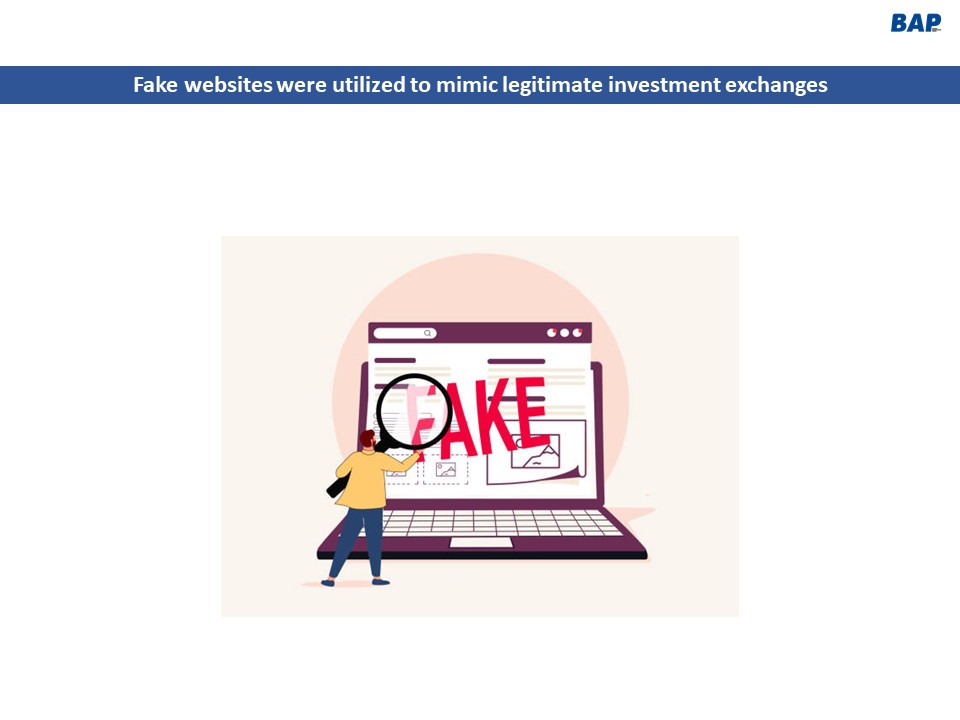
Kyar Phant’s technical teams prepare necessary fake profiles in advance; upon finding a victim, they converse to build intimacy and entice them to participate and invest shares in their business. Subsequently, they provide a link to a fraudulent website displaying fake stock figures to convince the victim to buy shares. About a week after purchasing, the stock value and the victim's assets appear to rise. In this way, victims are lured into buying more as stock prices continue to "increase," eventually leading to the theft of all invested funds.
"Deepfake" refers to videos, photos, or audio files created using AI (Artificial Intelligence) technology to replace a person's face, voice, or posture with another's, making it indistinguishable from reality.
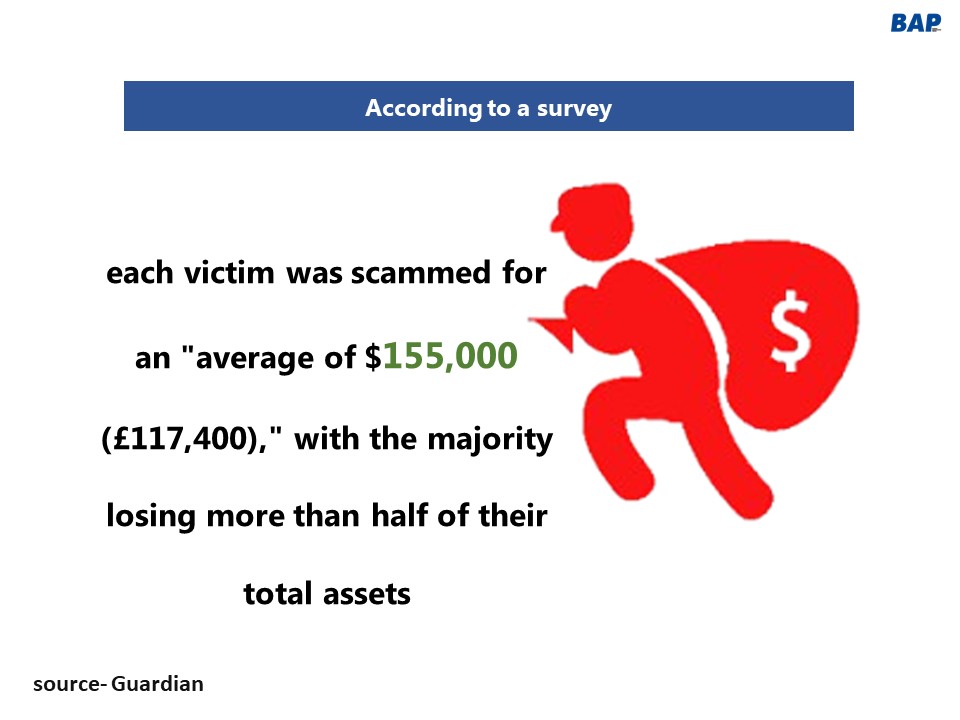
These lucrative Kyar Phant businesses also pay substantial wages to their workers. A basic worker at a Kyar Phant center earns between 10,000 and nearly 15,000 Thai Baht per month. This amount—equivalent to approximately 1.5 to 2 million Myanmar Kyats—is only the base level.
When recruiting workers from international locations, including Myanmar, they use social media platforms like Telegram and Facebook.

In Cambodia, another Southeast Asian nation, the Department of Justice (DOJ) last month seized $15 billion in cryptocurrency from a company accused by the U.S. government of operating scam camps across the country. According to a Guardian report, that amount is equivalent to nearly half of Cambodia's economy.
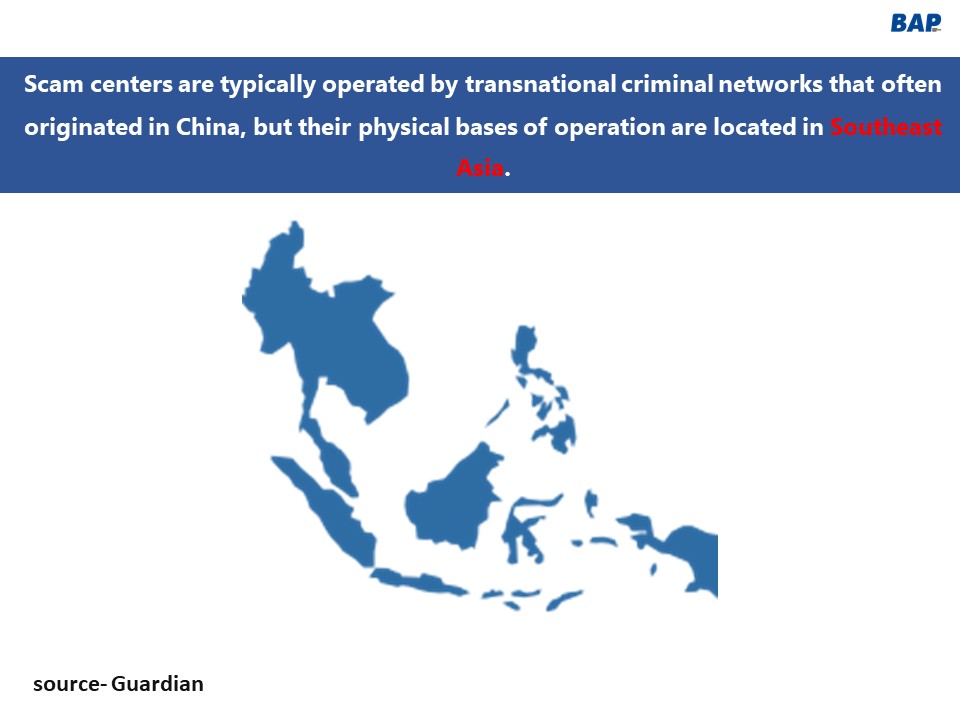
Southeast Asia: A Hub for Criminal Networks

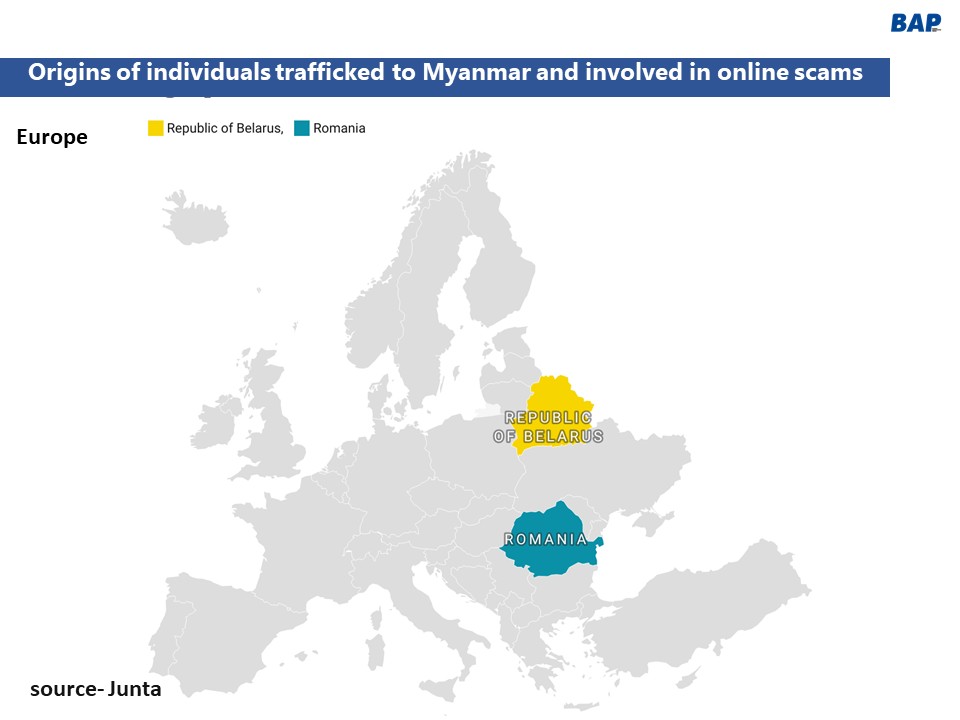
According to lists recently compiled by BAP, the points of origin for people trafficked into Myanmar to work in Kyar Phant centers include 23 African countries, 5 East Asian countries, 8 Southeast Asian countries, 5 South Asian countries, 3 Central Asian countries, and 2 European countries.
Origins of individuals trafficked to Myanmar and involved in online scams

Origins of individuals trafficked to Myanmar and involved in online scams
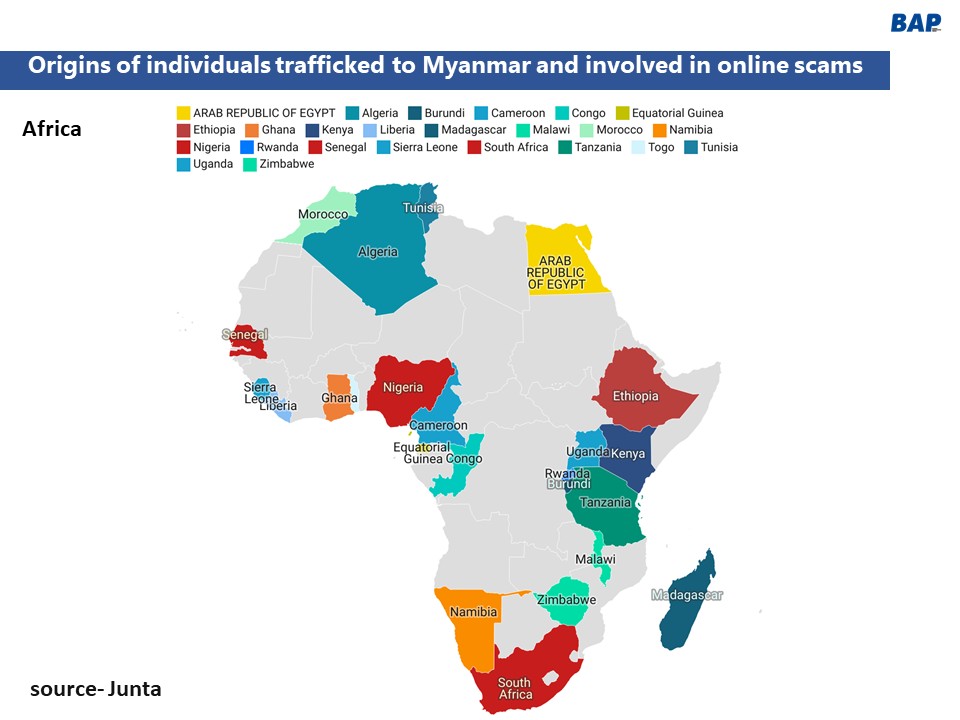
Origins of individuals trafficked to Myanmar and involved in online scams
From January 2025 to mid-December 2025, prize money awarded by the Karen Border Guard Force (BGF) in sports competitions:
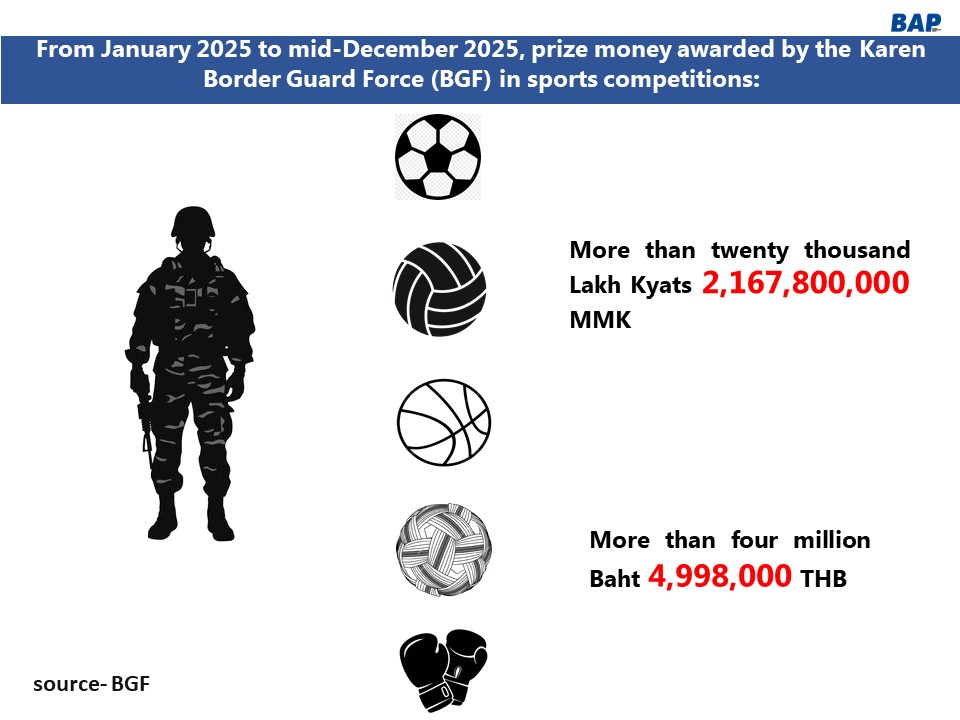
In Karen Border Guard territories, sports competitions are often included in the birthday celebrations of BGF leaders’ family members. According to records found by BAP, a basketball tournament was awarded prizes up to 400,000 Thai Baht. In August of this year, at the birthday football match for BGF leader Saw Chit Thu’s grandson, the first prize alone was set at 2,000 Lakh Kyats (200 million MMK).
These tournament prizes are higher than the maximum amount awarded for an entire season of the Myanmar National League (MNL). The highest prize money for the MNL is under 1,000 Lakh Kyats. For the 2024-2025 football season, the first-prize winning team in March received only 700 Lakh Kyats.
BAP’s calculations only include the prizes from sports competitions held by the Karen Border Guard and do not include the cash or gold bars personally gifted by BGF leaders.
Among Karen armed groups, the BGF maintains the closest relationship with the military.
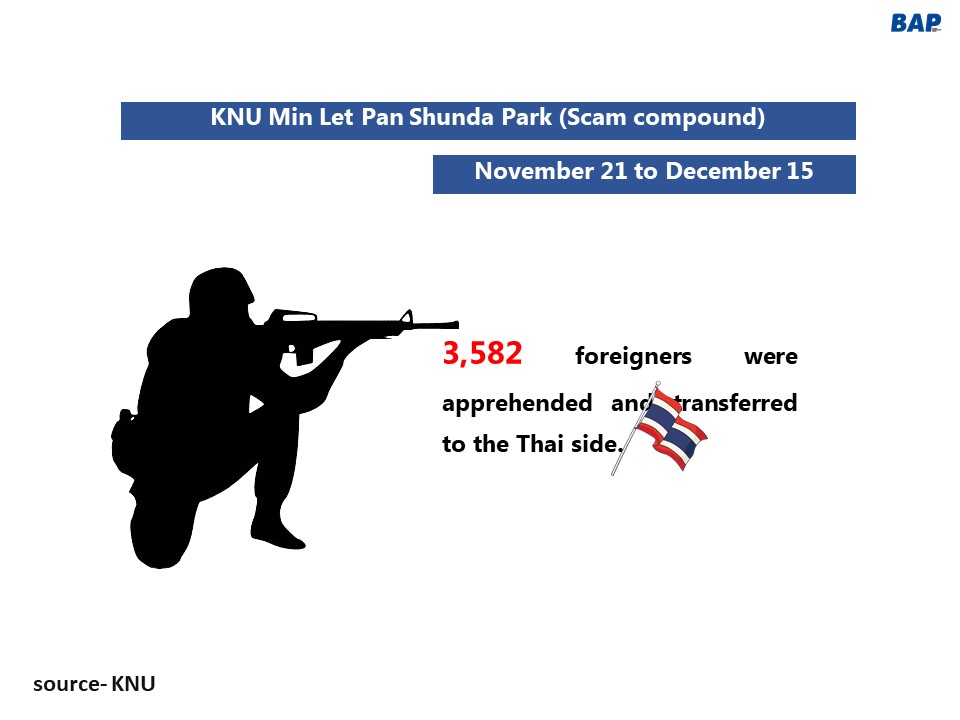
Regarding the Kyar Phant issue, the Karen armed group KNU and the military have been exchanging accusations in the newspapers. According to information investigated by BAP, the KNU raid on the Min Let Pan scam center was merely a raid on a casino that could be considered the smallest among nearly 50 such centers along the Myanmar-Thai border. That casino was being secured by the DKBA, which has a ceasefire with the military. On November 21, the KNU/KNLA raided the DKBA camp.
During the raid, which captured over 3,500 people inside the scam center, the KNU handed over the individuals, along with mobile phones and internet-related equipment, to the Thai side.
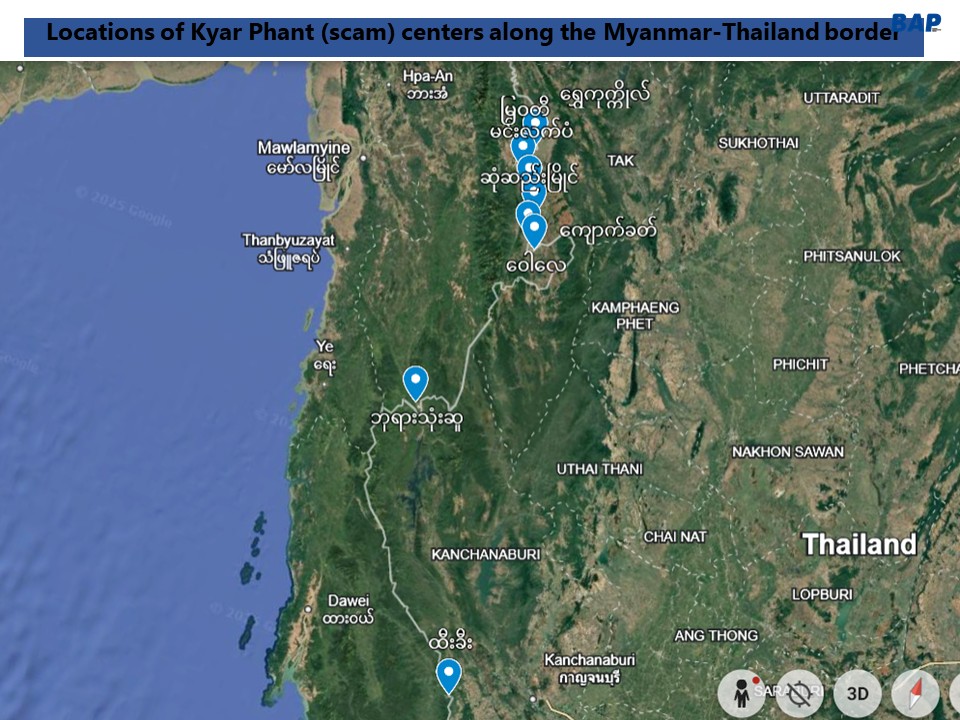
In Myanmar, scam centers are numerous in border areas. They are prevalent in areas controlled by pro-military People’s Militia Forces (BGF) and ethnic armed organizations.
There are no fewer than 35 Kyar Phant operations across a total of seven towns on the China-Myanmar border: (1) Muse, (2) Lashio, (3) Laukkai, (4) Pangsang, (5) Mong Pawk, (6) Mong La, and (7) Kengtung.
Along the Thai-Myanmar border, there are around 50 operations across ten towns: (1) Tachileik, (2) Shwe Kokko, (3) Myawaddy, (4) Phalu, (5) Kyauk Khet, (6) Son See Myaing, (7) Walley, (8) Three Pagodas Pass, (9) Htee Khee, and (10) Kawthaung.
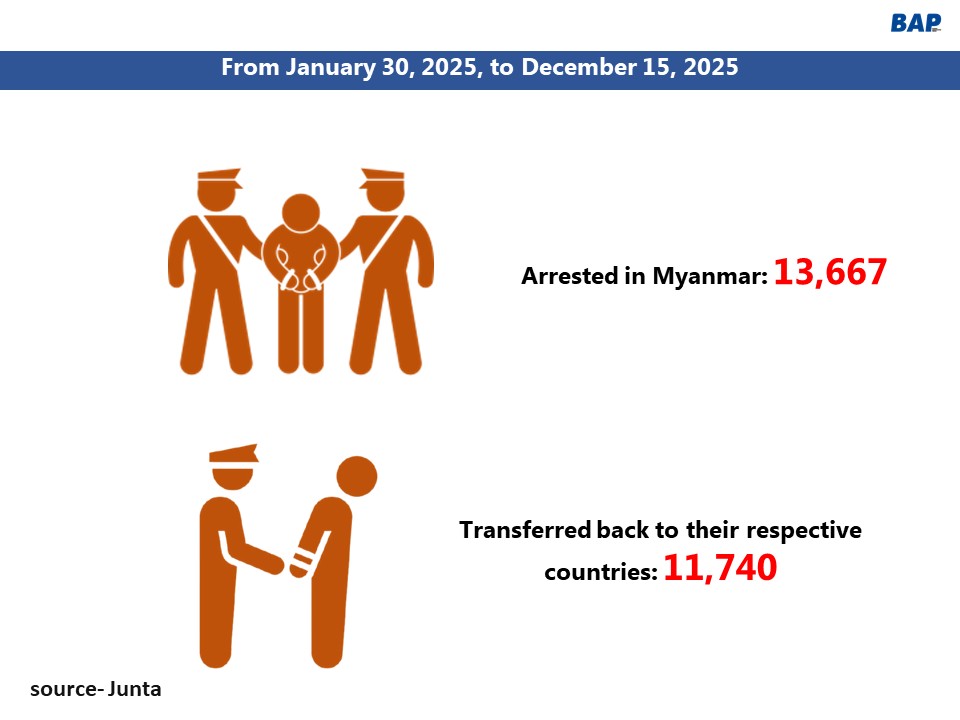
After the U.S. government formed a "Strike Force" to suppress online scams, the Myanmar military junta also began conducting arrests in the territory of its ally, the BGF.
According to statements from the military junta, there have been 13,667 arrests from the beginning of this year until December 15. Among them, 11,740 individuals have been handed back to their respective countries, and nearly 2,000 people are reportedly being processed for transfer.

Among the scam defendants transferred from Myanmar to China, the Chinese government in September sentenced 11 people to death, including the Ming family—Ming Guoping (son of the late Kokang tycoon Ming Xuechang) and his grandson Ming Zhenzhen.
In November, a court in Shenzhen, Guangdong Province, also sentenced five members of the Bai family, including former Kokang Autonomous Region Chairman Bai Suocheng, to death.
Furthermore, in early December, Chinese authorities issued rewards for a list of 100 wanted scam leaders, including those connected to operations in Northern Shan.
While scam crackdowns are being carried out extensively on the Myanmar side under pressure from China and the U.S., the industry remains deeply rooted under corruption of the Myanmar military and the protection of armed groups.
Burma Associated Press
Top News
လွန်ခဲ့သော ၉ ရက် က
လွန်ခဲ့သော ၂၄ ရက် က