

Data
Data on Past and Present Elections
လွန်ခဲ့သော ၅ လ က
BAP, December 3.
The military junta is set to hold a part of "sham" election at the end of December this year.
This upcoming election will be the fourth general election held since the ratification of the 2008 Constitution.
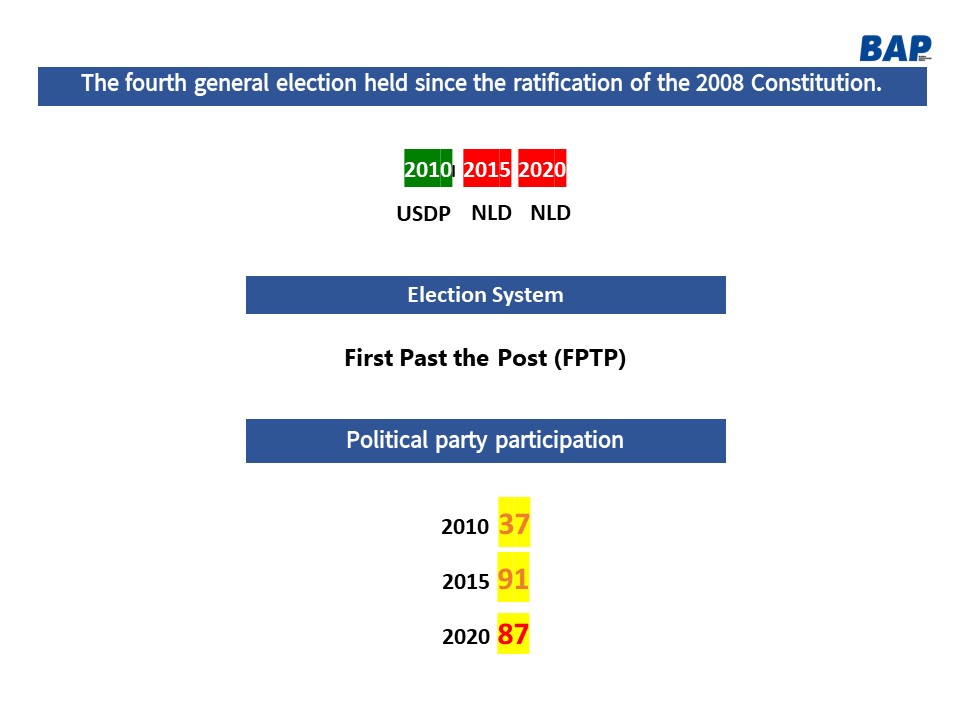
General Elections Held by the Military Regime Since the Ratification of the 2008 Constitution
In the three previous elections (2010, 2015, and 2020), the Union Solidarity and Development Party (USDP) won once, while the National League for Democracy (NLD) won twice.
The previous elections utilized the First Past the Post (FPTP) system.
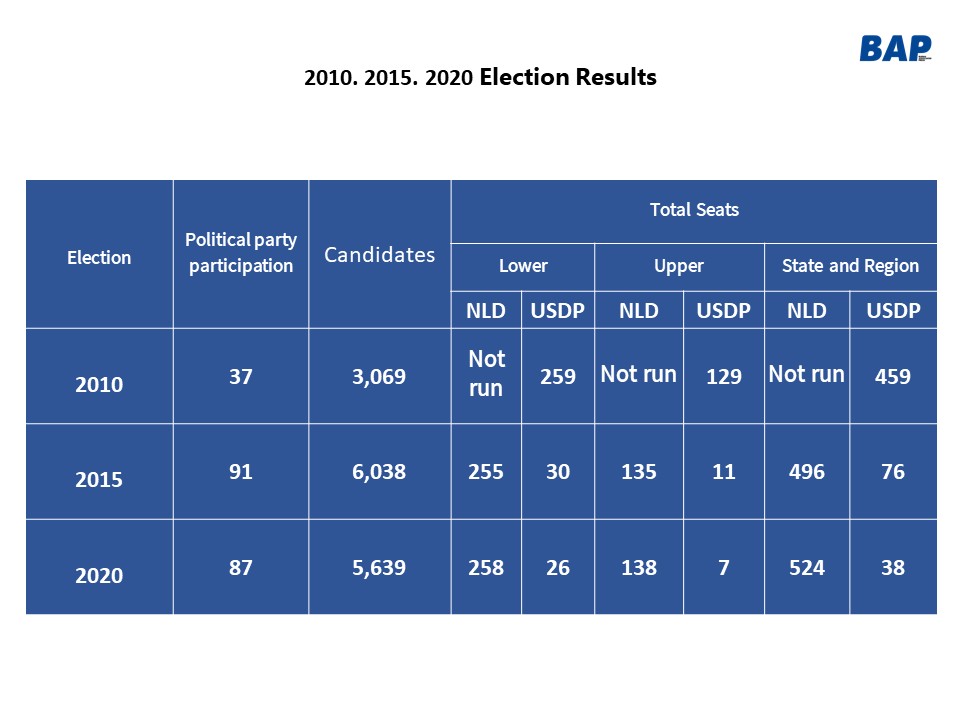
Regarding political party participation, the 2015 election saw the highest number of contesting parties, with 91 political parties participating. In comparison, there were 37 parties in 2010 and 87 parties in 2020.
The number of candidates competing in various constituencies was 3,069 in 2010, 6,038 in 2015, and 5,639 in 2020.
2010, 2015, and 2020 Election Results
Except for the 2010 election, in which the NLD did not participate, the USDP did not secure enough votes to form a government in the other two elections.
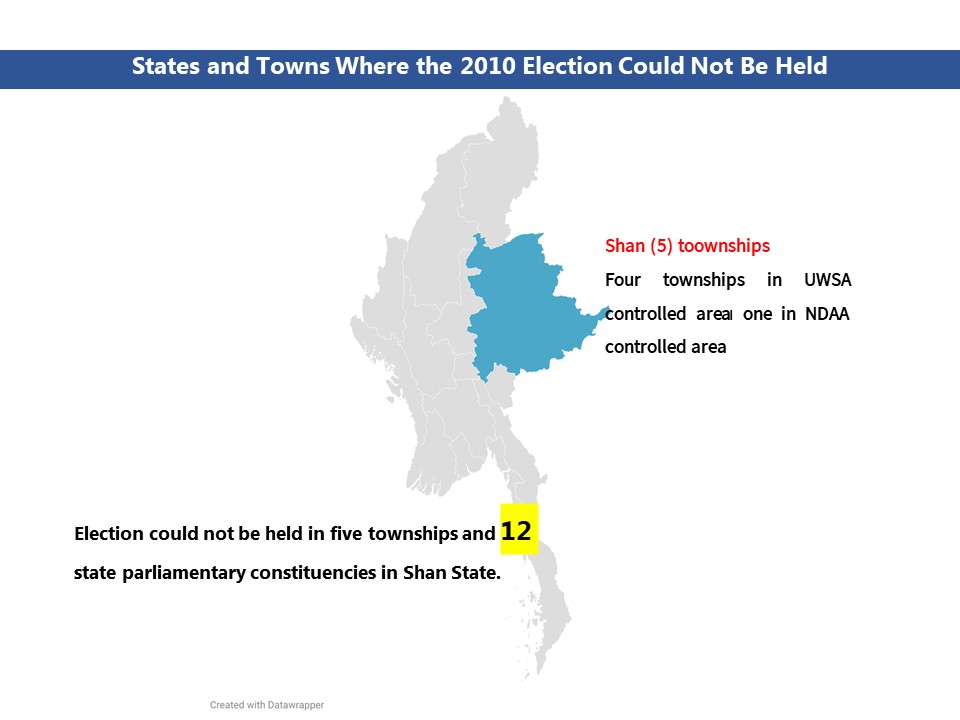
States and Towns Where the 2010 Election Could Not Be Held
In past elections, there were townships and constituencies where voting could not be held.
In the 2010 election, election could not be held in five townships and 12 state parliamentary constituencies in Shan State.

States and Towns Where the 2015 Election Could Not Be Held
Similarly, in 2015, there were 7 townships in Shan State and 31 townships that could not hold partial elections.

States and Towns Where the 2020 Election Could Not Be Held
Elections have never been held in any of the three previous cycles in the four towns controlled by the United Wa State Army (UWSA) in Shan State (Pangkham/Pangsang, Na-hpan, Pangwaun, and Mongmao) and the Mongla Township controlled by the National Democratic Alliance Army (NDAA).
Among the three elections, the 2020 election, held under the National League for Democracy government, saw the cancellation of voting in six townships in Shan State and nine townships in Rakhine State due to regional instability. The Rakhine townships where elections could not be held due to conflict were areas won by the Arakan National Party in 2015.
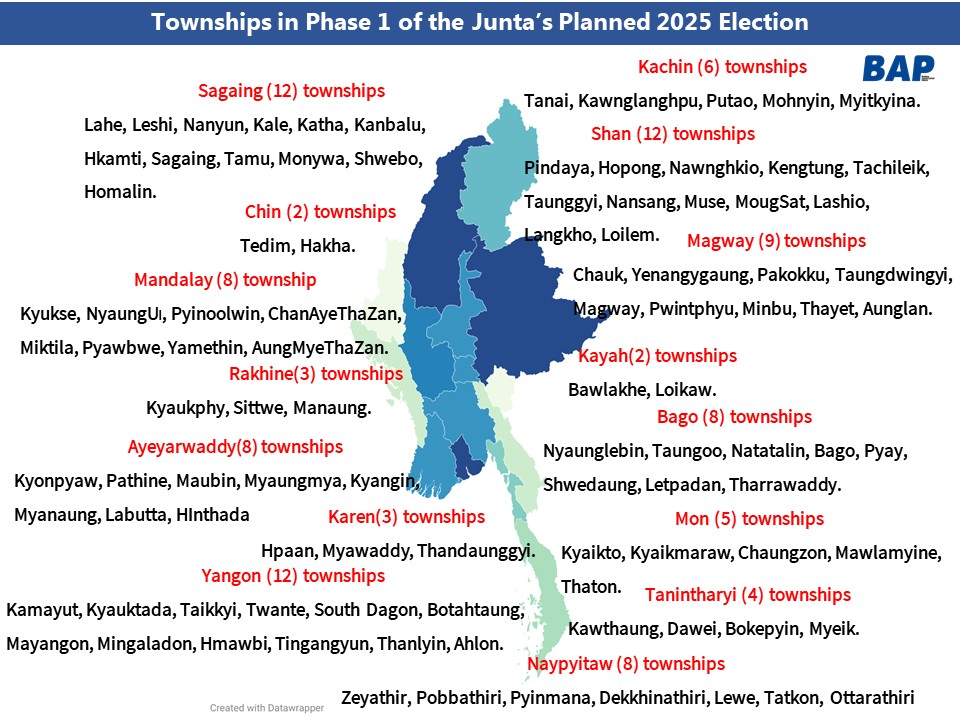
Townships in Phase 1 of the Junta’s Planned 2025 Election
The military junta, having annulled the 2020 election results, is preparing to hold an election of its own design starting this coming December.
Initially, the first phase of the election will be held in 102 townships on December 28. Most townships in Kachin, Rakhine, Kayah, Karen, and Chin States, where fighting between the military and resistance forces is intense, were not included in the first phase of the election.

States/Regions and Towns Where the 2025 Election Could Not Be Held
Among the elections held since the adoption of the 2008 Constitution, the junta's planned 2025 election sets a record for the highest number of townships where voting cannot be held.
There are currently 56 townships nationwide where elections cannot be conducted.
Among them, Shan State has the highest number with 17 townships, followed by Sagaing and Rakhine with 10 townships each, Magway with 5 townships, Kachin and Chin with 4 townships each, and Mandalay and Kayah (Karenni) with 3 townships each.
Elections cannot be held in 56 townships for the Pyithu Hluttaw (House of Representatives) under the FPTP system, 9 constituencies (covering 18 townships) for the Amyotha Hluttaw (House of Nationalities) under the FPTP system, and 56 townships for State and Regional Hluttaws.
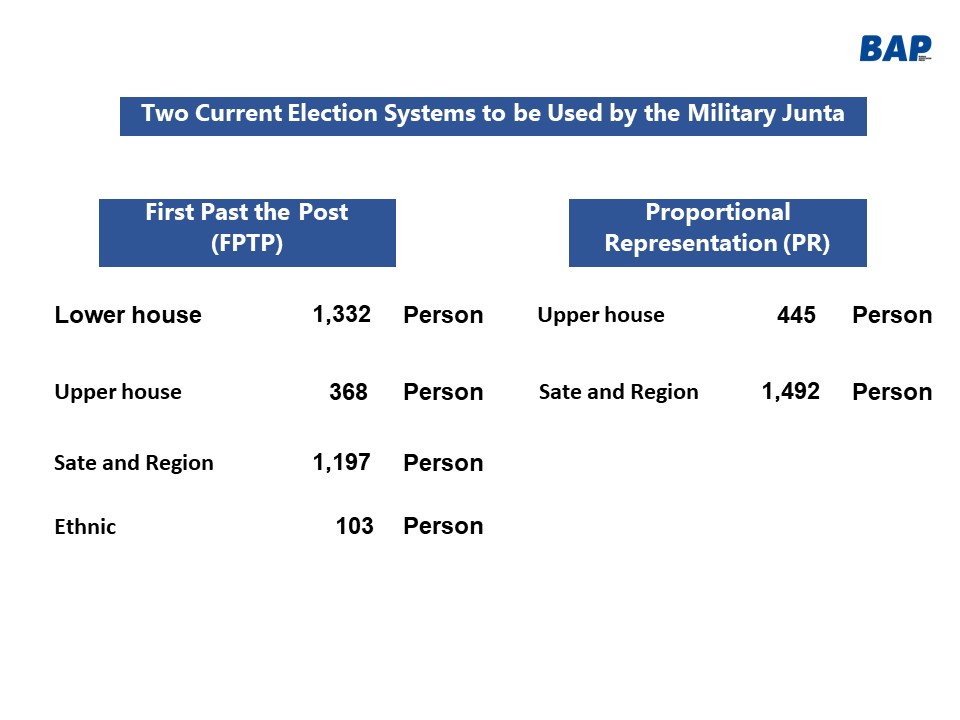
Two Current Election Systems to be Used by the Military Junta
Unlike previous elections, the junta will utilize two systems this time: the First Past the Post (FPTP) system and the Proportional Representation (PR) system.
Under the FPTP system, there are 1,332 candidates contesting for the Pyithu Hluttaw (House of Representatives), 368 for the Amyotha Hluttaw (House of Nationalities), 1,197 for the State and Region Hluttaws, and 103 for the Ethnic Affairs posts.
Under the Proportional Representation (PR) system, there are 445 candidates for the Amyotha Hluttaw and 1,492 candidates for the State and Region Hluttaws.

Contesting Political Parties
A total of 57 parties will compete in the junta's election, with six parties competing nationwide and 51 parties competing at the state and regional levels.
The Union Solidarity and Development Party (USDP), formed by former generals and military retirees, is set to field the highest number of candidates nationwide in the upcoming junta election.

Number of Candidates Per Political Party in the Junta's Election
Among the six parties competing nationwide, the USDP will contest with over a thousand candidates (1,042).
Following them, the National Unity Party stands second with 690 candidates, and Daw Thet Thet Khine’s People’s Pioneer Party follows with 667 candidates.
The Shan and Ethnic Democratic Party (White Tiger Party) will field 576 candidates, the People’s Party led by U Ko Ko Gyi will field 501 candidates, and the Myanmar Farmers Development Party will field 423 candidates in the junta's election.
Among the political parties campaigning within specific states and regions, 51 parties have submitted a total list of 945 candidates, while there are 93 independent candidates.
Therefore, the total number of candidates competing in various constituencies in the junta election stands at 4,937.
The junta has announced that the first phase of the election will be held on December 28. Major parties such as the National League for Democracy (NLD), which won the 2020 election, and the Shan Nationalities League for Democracy (SNLD), which secured the third-highest number of seats, are boycotting the election.
Burma Assoicated Press
Top News
လွန်ခဲ့သော ၉ ရက် က
လွန်ခဲ့သော ၂၄ ရက် က